

If you are pursuing B.Com, you may be wondering what to do after B.Com — whether to start working, pursue higher studies, prepare for government jobs or choose a professional course. A B.Com degree builds knowledge in accounting, finance, taxation, business and management, opening doors to several career options after B.Com and further education opportunities.
Some graduates choose jobs after B.Com to gain practical experience, while others explore courses after B.Com to build specialized knowledge. Options may include M.Com, MBA, CA, CMA, CS, finance-related qualifications, analytics, digital marketing and other skill-based programs. You can also explore government or private-sector opportunities based on your skills and career goals.
What Can I Do After B.Com?
There are several pathways available after completing B.Com. You can choose higher studies, professional qualifications, private or government jobs or short-term skill-based courses based on your interests and career goals.
The main options available after B.Com include:
- Higher Studies: Consider options such as M.Com or MBA for advanced education and specialization.
- Professional Courses: Qualifications such as CA, CMA, CS, ACCA and CFA can help you build specialized expertise.
- Private Jobs: Explore opportunities in accounting, finance, banking, taxation, operations, sales and other private-sector areas.
- Government Jobs: B.Com graduates can explore banking, SSC, UPSC, state-level and other eligible government opportunities based on recruitment requirements.
- Short-Term Courses: Develop job-oriented skills through Data Analytics, Business Analytics, Digital Marketing, Financial Modelling, Excel or accounting-related courses.
If you are confused about what to do after B.Com, the right career options after B.Com depend on your career goals, interests and the skills you want to develop.
What Jobs Can I Get After B.Com?
If you are wondering what jobs can I get after B.Com, you can explore private and government opportunities in accounting, finance, taxation, banking, insurance, marketing and business operations.
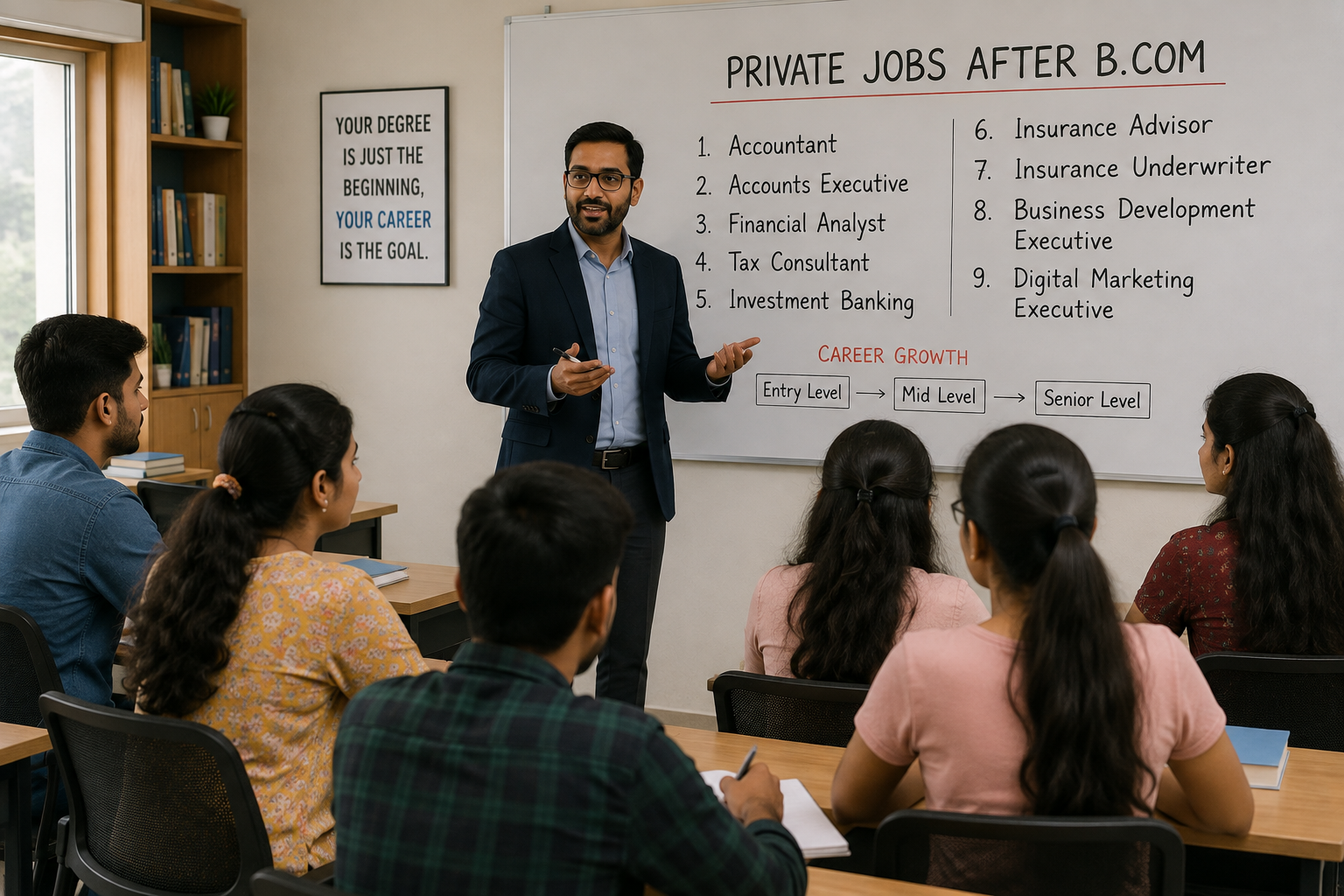
Private Jobs After B.Com
Jobs after B.Com for freshers can help graduates gain practical experience in accounting, finance, banking, taxation, insurance, marketing and business operations.
Common private jobs after B.Com include:
1. Accountant
An accountant is a professional who manages a company’s or organization’s financial records and transactions.
Role & Responsibilities
- Maintains financial records
- Handles invoices and ledger entries
- Performs reconciliations
- Supports routine financial reporting
Average Salary in India
- Entry-level: Rs. 2.5–4 LPA approx.
- Experienced: Rs. 5–10 LPA approx.
Educational Qualification
- B.Com
- Knowledge of accounting principles and taxation is beneficial.
Relevant Courses
Short-term courses to develop practical skills for entry-level accounting roles.
- Tally with GST
- ERP accounting software
- Advanced Excel
- Accounting & Taxation
Key Skills
- Accounting
- Excel
- Bookkeeping
- GST basics
- Accounting software
- Attention to detail
Job Scope/Career Path
- Workplaces: Companies, CA firms, manufacturing, retail and financial services
- Career Path: Accountant → Senior Accountant → Accounts Manager → Finance Manager
2. Accounts Executive
Accounts executive is a finance and accounting professional who handles the day-to-day accounting activities of a company.
Role & Responsibilities
- Handles billing
- Bookkeeping
- Ledger entries
- Documentation
- Reconciliations
- Day-to-day accounting activities
Average Salary in India
- Entry-level: Rs. 2.5–4 LPA approx.
- Experienced: Rs. 5–8 LPA approx.
Educational Qualification
- B.Com
- Related commerce qualification.
Key Skills
- Tally/accounting software
- Excel
- Bookkeeping
- GST basics
- Accuracy
Job Scope/Career Path
- Career Progression: Accounts Executive → Senior Accounts Executive → Accountant → Accounts Manager
- Growth: Can move into senior accounting or finance roles with experience and additional skills.
3. Financial Analyst
Financial analyst is a professional who studies financial data to help businesses or investors make informed financial decisions.
Role & Responsibilities
- Analyses financial data
- Prepares reports
- Supports budgeting and forecasting
- Helps evaluate business performance
Average Salary in India
- Entry-level: Rs. 3.5–6 LPA approx.
- Experienced: Rs. 8–18 LPA approx.
Educational Qualification
- B.Com: Finance or Accounting background
- Financial Modelling: Training beneficial
- Advanced Excel: Practical knowledge beneficial
- Financial Analysis: Relevant training beneficial
Key Skills
- Financial analysis
- Excel
- Financial modelling
- Data interpretation
- Communication
- Analytical thinking
Job Scope/Career Path
- Workplaces: Banks, NBFCs, consulting firms, corporate finance teams and financial services companies
- Career Path: Financial Analyst → Senior Financial Analyst → Finance Manager → FP&A Manager/Professional
4. Tax Consultant
A tax consultant helps individuals and businesses with tax calculations, documentation, compliance and return preparation.
Role & Responsibilities
- Tax documentation
- Tax calculations
- Tax compliance
- Tax return preparation
- Client tax requirements
Average Salary in India
- Entry-level: Rs. 3–5 LPA approx.
- Experienced: Rs. 8–15 LPA approx.
Educational Qualification
- B.Com: Commerce or Accounting background
- Taxation: Knowledge of income tax and GST
- Additional Qualification: Taxation certification can be beneficial
Key Skills
- Income-tax basics
- GST knowledge
- Accounting
- MS Excel
- Tax documentation
- Attention to detail
Job Scope/Career Path
- Workplaces: CA firms, accounting firms, businesses and consulting organizations
- Career Path: Tax Assistant → Tax Executive → Tax Consultant → Tax Manager
5. Investment Banking Roles
Investment banking roles support financial transactions, valuations, fundraising, mergers and acquisitions and financial analysis.
Role & Responsibilities
- Financial research
- Company and market analysis
- Financial modelling
- Valuation support
- Preparing presentations and reports
- Supporting financial transactions
Average Salary in India
- Entry-level: Rs. 6–12 LPA approx.
- Experienced: Rs. 15–30+ LPA approx.
Educational Qualification
- B.Com: Commerce, finance or accounting background
- Finance Training: Financial modelling or valuation training
- Additional Qualification: CFA or relevant finance certification can be beneficial
- Experience: Internships can help build practical exposure
Key Skills
- Financial modelling
- Valuation
- Advanced Excel
- Financial statement analysis
- Financial research
- Communication
Job Scope/Career Path
- Industries: Investment banking, financial advisory, consulting, corporate finance
- Career Path: Analyst → Associate → Vice President → Senior Leadership
6. Insurance Advisor
Helps customers understand insurance products, assess their needs and choose suitable policies.
Role & Responsibilities
- Explain insurance products and coverage
- Assess customer insurance needs
- Recommend suitable policies
- Assist with policy applications and documentation
- Support customers with policy-related queries
Average Salary in India
- Entry-level: Rs. 2.5–4.5 LPA approx.
- Experienced: Rs. 5–10 LPA approx.
Educational Qualification
- B.Com: Relevant for entry-level opportunities
- Insurance Knowledge: Understanding of insurance products and policies
- Licensing: Required regulatory/licensing requirements may apply depending on the role
Key Skills
- Communication
- Customer service
- Insurance product knowledge
- Sales
- Relationship management
- Financial understanding
Job Scope/Career Path
- Workplaces: Insurance companies, agencies, banks and financial service organizations
- Career Path: Insurance Advisor → Senior Advisor/Relationship Manager → Sales Manager → Branch/Business Manager
7. Insurance Underwriter
Evaluates insurance applications and risks to help determine suitable coverage and policy terms.
Role & Responsibilities
- Review insurance applications
- Assess potential risks
- Verify applicant information and documents
- Evaluate coverage requirements
- Help determine policy terms and conditions
- Support underwriting decisions
Average Salary in India
- Entry-level: Rs. 3–5 LPA approx.
- Experienced: Rs. 6–12 LPA approx.
Educational Qualification
- B.Com: Commerce or finance background
- Insurance Knowledge: Basic understanding of insurance products
- Risk Assessment: Knowledge of risk evaluation and financial analysis
Key Skills
- Risk assessment
- Analytical thinking
- Financial understanding
- Documentation
- Attention to detail
- Decision-making
Job Scope/Career Path
- Workplaces: Insurance companies, financial services organizations and underwriting departments
- Career Path: Underwriting Assistant → Underwriter → Senior Underwriter → Underwriting Manager
8. Business Development Executive
A business development executive helps a company identify potential customers, generate leads, build client relationships and support business growth.
Role & Responsibilities
- Identify potential customers and business opportunities
- Generate and follow up on leads
- Communicate with prospective clients
- Maintain customer relationships
- Support sales and business development activities
- Conduct basic market research
Average Salary in India
- Entry-level: Rs. 2.5–5 LPA approx.
- Experienced: Rs. 5–10 LPA approx.
Educational Qualification
- B.Com: Relevant for entry-level roles
- Sales & Marketing: Basic knowledge can be beneficial
- Digital Skills: CRM and business communication skills can help
Key Skills
- Communication
- Sales
- Negotiation
- Customer relationship management
- Market research
- Presentation skills
- Lead generation
Job Scope/Career Path
- Workplaces: Finance, banking, technology, education, retail and other industries
- Career Path: Business Development Executive → Business Development Manager → Sales Manager → Senior Management
9. Digital Marketing Executive
A digital marketing executive promotes a business’s products or services through SEO, social media, websites, email and online advertising.
Role & Responsibilities
- SEO support
- Social media management
- Digital campaign support
- Content promotion
- Email marketing
- Performance tracking
Average Salary in India
- Entry-level: Rs. 2.5–4.5 LPA approx.
- Experienced: Rs. 5–10 LPA approx.
Educational Qualification
- B.Com: Relevant for entry-level roles
- Digital Marketing: Training can be beneficial
- SEO/Google Ads: Additional certification can help
Key Skills
- SEO
- Social media marketing
- Content marketing
- Google Ads
- Digital analytics
- Communication
Job Scope/Career Path
- Workplaces: Digital agencies, e-commerce companies, startups and corporate marketing teams
- Career Path: Digital Marketing Executive → Digital Marketing Specialist → Digital Marketing Manager → Head of Digital Marketing
Important Note: If you are considering what to do after B.Com or which job to apply for, remember that salary figures mentioned above are approximate and vary by employer, role, location, qualifications, experience and performance.
Overall, private jobs after B.Com offer diverse career paths across finance, accounting, insurance, marketing and business, depending on your skills and career goals.
B.Com graduates can explore government jobs after B.Com through various central and state-level recruitment examinations, depending on the eligibility criteria.
If you are considering what to do after B.Com, government jobs may be an option, with some opportunities open to graduates from any stream while others require specific subjects, qualifications or additional criteria.
1. Banking Jobs
Relevant Roles
- Probationary Officer (PO)
- Clerk
- Specialist Officer (SO) where eligible
Common Recruitment Routes
- IBPS
- SBI
- Other participating banking institutions
Selection Process
- Written examination
- Interview, where applicable
- Other tests or stages depending on the post
2. SSC Jobs
Examinations
- SSC CGL: Graduate-level posts such as Auditor, Accountant, Tax Assistant and ASO.
- SSC CHSL: 12th-level posts, with eligibility based on the specific notification.
Relevant Roles
- Auditor
- Accountant
- Tax Assistant
- Assistant Section Officer
- Other eligible Group B and Group C posts
Selection Process
- Computer-Based Examination: Conducted as per the respective SSC examination.
- Tier-II: Applicable to SSC CGL and conducted according to its prescribed pattern.
- Skill/Typing Test: Required for specific SSC CHSL/CGL posts, where applicable.
- Document Verification: Conducted for candidates shortlisted for appointment.
- Final Selection: Based on the applicable examination stages, merit and post preferences.
3. UPSC Civil Services
Services
- Indian Administrative Service (IAS)
- Indian Police Service (IPS)
- Indian Revenue Service (IRS)
- Other services included under the examination
Eligibility
- Educational Qualification: Bachelor’s degree from a recognized university or equivalent.
- Age: As per the latest UPSC eligibility criteria.
Selection Process
- Preliminary Examination
- Main Examination
- Personality Test/Interview
- Final selection based on the prescribed process and merit
4. State Government Jobs
Common Opportunities
- Administrative positions
- Accounts-related positions
- Revenue-related positions
- Tax-related positions
- Departmental and other graduate-level posts
Recruitment Routes
- State Public Service Commission examinations
- State government recruitment examinations
- Department-specific recruitment
Selection Process
- Written examination
- Skill or aptitude test, where applicable
- Interview, where applicable
- Document verification
5. Public-Sector & Financial Roles
Possible Employers
- Public-Sector Banks: SBI, PNB
- Government Organizations: Indian Railways, India Post
- Public-Sector Undertakings (PSUs): ONGC, NTPC, Indian Oil Corporation
- Financial Institutions: NABARD, SIDBI
- Insurance Sector: LIC
- Government Departments: Income Tax Department, Department of Revenue, Ministry of Finance
Selection Process
- Recruitment examination, where applicable
- Interview, where applicable
- Skill or other post-specific tests
- Document verification
Important Note: If you are considering what to do after B.Com, remember that a B.Com degree does not guarantee eligibility for every government position. Requirements vary by examination and post, so always check the latest official notification.
The career options after B.Com include private jobs, government opportunities and specialized career paths based on your skills and goals.
Which Courses Can I Do After B.Com?
If you are considering what to do after B.Com, you can explore the best courses after B.Com, including professional qualifications, postgraduate programs and short-term courses based on your career goals, interests and budget.
Professional Courses After B.Com
Professional qualifications can help you specialize in accounting, taxation, corporate compliance, investment or finance.
1. CA (Chartered Accountancy)
- Best for: Accounting, auditing, taxation and financial reporting
- Career Roles: Chartered Accountant, Auditor, Tax Consultant, Finance Professional
- Key Skills: Accounting, taxation, auditing, financial reporting
- Qualification: ICAI examinations and prescribed practical training
- Career Path: CA → Senior Finance/Audit/Tax Role → Finance Manager or Practice
2. CS (Company Secretary)
- Best for: Corporate law, compliance and governance
- Career Roles: Company Secretary, Compliance Executive, Corporate Governance Professional
- Key Skills: Corporate law, compliance, communication, documentation
- Qualification: ICSI examinations and prescribed training
- Career Path: CS Trainee → Company Secretary → Senior Compliance/CS Role
3. CMA (Cost and Management Accountancy)
- Best for: Costing, budgeting, financial management and business decision-making
- Career Roles: Cost Accountant, Management Accountant, Finance Professional
- Key Skills: Cost accounting, budgeting, financial analysis
- Qualification: ICMAI examinations and prescribed training
- Career Path: Finance Executive → Management/Cost Accountant → Finance Manager
4. ACCA
- Best for: Accounting, finance, audit and international accounting
- Career Roles: Accountant, Financial Analyst, Audit Associate, Management Accountant
- Key Skills: Financial reporting, accounting, audit, IFRS, Excel
- Qualification: ACCA examinations and practical experience requirements
- Career Path: Accounts/Audit Associate → Senior Accountant/Auditor → Finance Manager
5. CFA (Chartered Financial Analyst)
- Best for: Investment analysis, financial markets, valuation and portfolio management
- Career Roles: Investment Analyst, Equity Research Analyst, Portfolio Analyst
- Key Skills: Financial analysis, valuation, financial modelling and research
- Qualification: CFA Program examinations and applicable requirements
- Career Path: Analyst → Senior Analyst → Investment/Portfolio Management Roles
Higher Studies After B.Com
M.Com
- Focus: Commerce, accounting, finance and taxation
- Best for: Academic knowledge, teaching, research, accounting and finance
- Career Scope: Accounting, finance, banking, taxation and education
MBA
- Focus: Management, finance, marketing, operations, HR or business analytics
- Best for: Management and corporate career paths
- Career Scope: Management, finance, marketing, consulting, operations and business development
Eligibility, examinations, training requirements, fees and admission criteria vary by qualification and institution. Check the respective official body’s latest requirements.
Which Course Is Best After B.Com?
There is no single best course after B.Com. Choose based on your career goals, interests, budget and preferred field.
|
Course |
Best For |
|
M.Com |
Commerce & academics |
| MBA |
Management |
|
CA |
Accounting & taxation |
| CMA |
Cost & finance |
|
CS |
Corporate compliance |
|
CFA |
Investments |
| Data Analytics |
Data & technology |
Short-Term Courses After B.Com
If you are wondering what to do after B.Com, choose a short-term course based on your career path and the skills you want to develop.
- Data Analytics – Data roles
- Business Analytics – Business analysis
- Digital Marketing – Marketing & SEO
- Financial Modelling – Finance roles
- Advanced Excel – Accounting & finance
- Accounting & Taxation – Tax & accounting
- Accounting Software – Accounts roles
Courses for International Accounting Jobs
If you are interested in international accounting jobs, consider developing skills in:
- IFRS
- Advanced Excel
- Financial Reporting
- Accounting Software: SAP, QuickBooks, Xero or Sage
- International Taxation: Where relevant to the target country and role
What to Do After B.Com for a High Salary?
If you are wondering what to do after B.Com for a high salary, focus on professional qualifications, specialized skills, relevant experience and career progression. Options may include CA, CMA, CFA, ACCA, finance, analytics and other specialized fields.
How to Choose the Right Option After B.Com?
- Career Goal: Identify your preferred field.
- Interests & Skills: Match your strengths with the career.
- Cost & Duration: Consider your time and budget.
- Career Opportunities: Research relevant jobs and growth options.

Why Choose Longowal Group of Colleges After B.Com?
Longowal Group of Colleges (LGC) offers B.Com (Hons.) for students interested in commerce and management. If you are considering what to do after B.Com, the program can provide a foundation for higher studies, professional courses and career opportunities.
- B.Com (Hons.): Commerce and management-focused education
- Practical Learning: Workshops, laboratories and academic resources
- Placement Support: Assistance with placements and interview preparation
- Industry Exposure: Guest lectures and industry-institute interaction
- Scholarships: Scholarship opportunities for eligible students
- Student Facilities: Library, hostel, sports and other campus facilities
Before choosing LGC, compare the available programs, eligibility, curriculum, fees and career relevance with your long-term goals.
Join B.Com at Longowal Group of Colleges
Plan what to do after B.Com based on your interests and career goals. Explore B.Com and career-oriented programs at Longowal Group of Colleges (LGC) and check the latest course details and admission information.
Longowal Group of Colleges (LGC)
Address: College Road, Derabassi, Distt. SAS Nagar, Mohali (Near Chandigarh)
Call Us: 99151-58000, 81466-58000
Mail Us: enquirylgcderabassi@gmail.com
Final Thoughts: What to Do After B.Com?
There is no single answer to what to do after B.Com. You can choose higher studies, professional qualifications, jobs, government exams or skill-based courses based on your career goals.
Consider your interests, skills, budget and long-term plans before choosing a pathway. Explore Longowal Group of Colleges (LGC) and take the next step toward your academic and career goals after B.Com.
FAQs – What to Do After B.Com? Jobs, Career Options & Courses
Q1. What is the best option for what to do after BCom?
Ans. The best option depends on your interests and goals. You can consider higher studies, professional qualifications, private jobs, government jobs or short-term courses.
Q2. What should I do after BCom for a high salary?
Ans. For higher earning potential, consider specialized qualifications such as CA, CFA, ACCA or CMA, along with relevant skills and work experience.
Q3. Which professional course is best after BCom?
Ans. CA, CMA, CS, ACCA and CFA are popular professional qualifications. The right choice depends on your preferred career field and long-term goals.
Q4. Which government job is best after BCom?
Ans. Banking, SSC, UPSC, state government and other public-sector opportunities can be considered based on your eligibility and career interests.
Q5. Can I pursue B.Com at Longowal Group of Colleges (LGC) and plan what to do after BCom?
Ans. Yes, Longowal Group of Colleges (LGC) offers B.Com (Hons.), which can provide a foundation for further education and career planning.