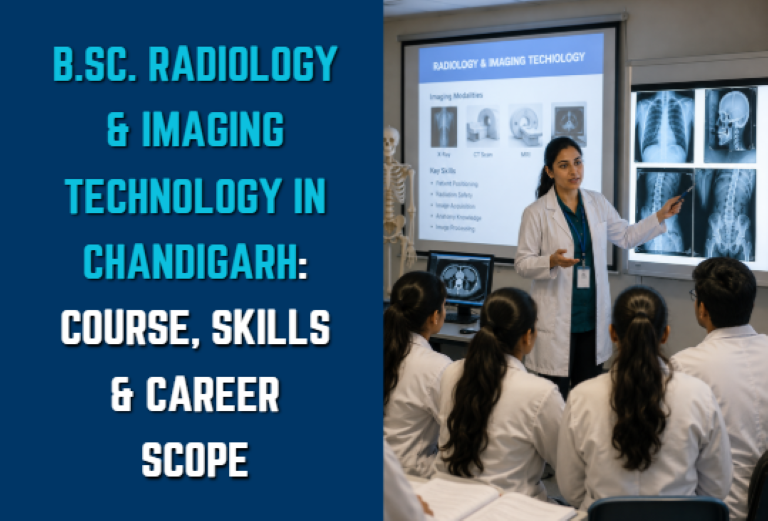
If you are planning a career in healthcare and have an interest in medical imaging, B.Sc. Radiology & Imaging Technology in Chandigarh can be a course worth exploring. It combines scientific knowledge with practical training in diagnostic imaging technologies used in modern healthcare.
Before choosing this field, you should understand what the course involves, the skills it can develop and the career opportunities it offers. A B.Sc. Radiology course provides practical exposure to diagnostic imaging while helping students build the technical knowledge and skills needed to pursue a career in healthcare.
If you want to build a career in Radiology & Imaging Technology, you can apply for the B.Sc. Radiology & Imaging Technology program at LGC to develop the knowledge and practical skills needed to enter this field.
What Is B.Sc. Radiology & Imaging Technology?
B.Sc. Radiology & Imaging Technology is a bachelor’s-level program designed for students interested in medical imaging and diagnostic healthcare.
A B.Sc. Radiology & Imaging Technology course generally covers:
- Anatomy and Physiology – Understanding the human body and its structures.
- Radiographic Principles – Learning the basic principles behind medical imaging.
- Medical Imaging Procedures – Understanding different diagnostic imaging techniques.
- Imaging Equipment – Learning about the operation and use of imaging technologies.
- Patient Care and Positioning – Developing safe and appropriate patient-handling skills.
- Radiation Safety – Understanding precautions for safe imaging practices.
- Practical Training – Applying classroom knowledge through hands-on and clinical learning.
The course combines medical knowledge with technical and practical training to help you understand how medical imaging technologies are used in clinical settings.
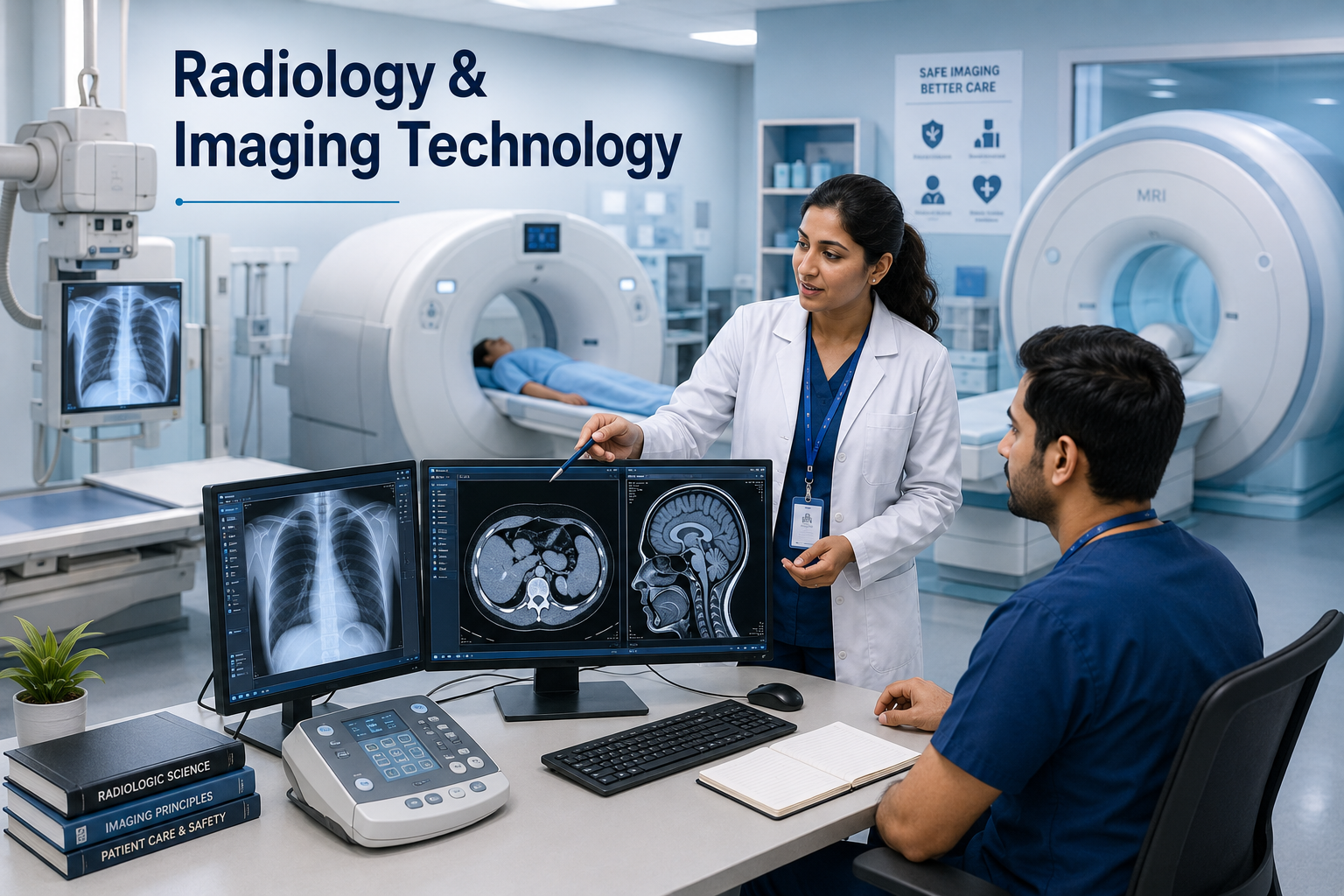
Radiology and Imaging Technology: What Does It Involve?
What is the difference between Radiology and Imaging Technology? – Radiology is the medical field concerned with using imaging to help examine and diagnose health conditions, while imaging technology focuses more on the technical processes, equipment and procedures used to produce diagnostic images.
Radiology and imaging technology covers several diagnostic imaging modalities. These may include:
- X-ray: Uses ionising radiation to produce images, commonly of bones and certain body structures.
- CT: Uses X-rays and computer processing to create detailed cross-sectional images.
- MRI: Uses magnetic fields and radio waves to produce detailed images of soft tissues and other structures.
- Ultrasound: Uses high-frequency sound waves to create images without ionising radiation.
Together, these imaging modalities help students understand how medical imaging supports diagnosis while developing the technical knowledge and practical skills needed to work in healthcare settings.
Career Scope After B.Sc. Radiology & Imaging Technology
What can you do after B.Sc. Radiology? Graduates can pursue entry-level opportunities in medical imaging and diagnostic services or continue their education to build expertise in a specific area. The B.Sc. Radiology career scope can vary based on practical experience, technical skills, additional qualifications, employer requirements and applicable professional regulations.
Career Opportunities After B.Sc. Radiology
Graduates may explore roles associated with different areas of medical imaging, such as:
- Radiologic Technologist – Supporting X-ray-based imaging procedures and maintaining safe imaging practices.
- CT Scan Technician – Assisting with CT imaging procedures and related patient preparation.
- MRI Technician – Supporting MRI procedures while following equipment and safety protocols.
- Ultrasound Technician – Working with ultrasound imaging systems, subject to role-specific qualifications and requirements.
- Medical Imaging Services – Supporting diagnostic imaging operations in hospitals, diagnostic centres and other healthcare facilities.
Where Can Radiology Graduates Work?
Medical imaging professionals can work in a range of healthcare settings, depending on their qualification, skills and job role.
Common workplaces include:
- Hospitals: Work as part of teams supporting imaging and diagnostic procedures.
- Diagnostic Centres: Assist with imaging services and routine diagnostic workflows.
- Imaging Centres: Work with specialized imaging equipment and related procedures.
- Healthcare Institutions: Support medical teams through imaging-related technical services.
Choosing the right B.Sc. Radiology & Imaging Technology program can help students build relevant skills and prepare for career opportunities across the growing medical imaging field.
B.Sc. Radiology Salary: What Can Graduates Expect?
As a student, you might be searching for B.Sc. Radiology & Imaging Technology in Chandigarh salary. In this case, it is important to know that there is no fixed salary for every graduate, as earnings can vary depending on experience, job role, employer, location and technical skills.
Key Insight: Salary figures found online should be treated as indicative rather than guaranteed. Building strong practical skills, gaining relevant experience and developing specialized expertise can improve your employability and help you pursue better career opportunities over time.
About Longowal Group of Colleges
Longowal Group of Colleges (LGC), Derabassi, is a higher education institution established in 1986, located near Chandigarh. The college offers various undergraduate and postgraduate programs, including B.Sc. Radiology & Imaging Technology, a 4-year program focused on medical imaging, technical knowledge and practical training.
LGC provides students with academic facilities such as laboratories, a library, hostels and other campus resources, along with practical learning and career-oriented support. For students looking for B.Sc. Radiology & Imaging Technology in Chandigarh, its location in Derabassi near the Tricity makes it a convenient option for pursuing a career-focused healthcare program.
B.Sc. Radiology Course Details
If you are looking for B.Sc. Radiology & Imaging Technology in Chandigarh or nearby, you should understand the key details of the program, including its duration, eligibility, learning approach and course focus before applying.
|
Course Detail |
Information |
|
Course Name |
B.Sc. Radiology & Imaging Technology |
| Course Level |
Undergraduate |
|
Duration |
4 years |
| Eligibility |
10+2 Medical stream or Diploma in MRIT |
|
Course Focus |
Medical imaging and diagnostic technology |
|
Learning Format |
Theoretical and practical learning |
| Lateral Entry |
Available separately for eligible diploma holders |
LGC lists B.Sc. Radiology & Imaging Technology as a 4-year undergraduate program and also offers a separate lateral-entry option for eligible students.
B.Sc. Radiology Eligibility and Admission
Before applying, it is important to understand the B.Sc. Radiology eligibility criteria and admission requirements.
Who Can Apply for B.Sc. Radiology?
Understanding the B.Sc. Radiology & Imaging Technology in Chandigarh eligibility and academic requirements is an important part of the admission process. At LGC, applicants should have completed 10+2 in the Medical stream or hold a Diploma in Medical Radiologic & Imaging Technology (MRIT).
Before applying, you should verify the latest eligibility criteria and admission requirements with LGC, as these requirements may be updated from time to time.
How to Apply for B.Sc. Radiology?
Once you meet the eligibility requirements, the admission process generally involves:
- Checking the current admission requirements.
- Completing the application form.
- Submitting the required academic and identity documents.
- Completing document verification and other admission formalities.
- Confirming course-related details with the college admission team.
Students should contact LGC directly for the latest information about admissions, fees, scholarships and seat availability.
B.Sc. Radiology Course Duration
The B.Sc. Radiology & Imaging Technology program at LGC is a 4-year undergraduate course. The duration provides students with time to progress from foundational concepts to more advanced aspects of medical imaging and practical learning.
LGC also offers a lateral-entry B.Sc. Radiology & Imaging Technology program separately for eligible diploma holders. Students considering lateral entry should confirm the applicable eligibility and admission requirements with the institution.
B.Sc. Radiology Subjects and Syllabus
The B.Sc. Radiology syllabus combines basic medical sciences with imaging technology, radiographic principles and practical learning. While the exact subjects may vary by university and curriculum, students can expect to study areas such as:
- Anatomy and Physiology
- Medical terminology
- Radiographic principles
- Medical imaging procedures
- Patient care and positioning
- Radiation protection and safety
- Medical imaging technology
- Image quality and evaluation
- Imaging equipment
- Clinical and practical learning
For students pursuing B.Sc. Radiology & Imaging Technology in Chandigarh, it is important to look beyond the subject list and consider whether the curriculum provides a balanced mix of scientific knowledge, technical understanding, safety practices and practical application.
Important Note: Students should confirm the latest semester-wise syllabus directly from LGC or the relevant academic documentation before relying on detailed subject information.
Skills You Develop During B.Sc. Radiology & Imaging Technology
This program can help you develop the technical and professional skills needed to work effectively in medical imaging environments.
- Technical Skills: Understand imaging procedures and basic technical principles.
- Equipment Handling: Learn the safe and appropriate use of imaging equipment.
- Attention to Detail: Maintain accuracy in patient positioning and imaging procedures.
- Patient Communication: Communicate clearly and support patient comfort.
- Safety: Follow essential radiation protection and safety practices.
- Teamwork: Work effectively with doctors, nurses and other healthcare professionals.
- Problem-Solving: Identify practical challenges and follow appropriate protocols.
A good radiology program should help students develop more than theoretical knowledge. At Longowal Group of Colleges (LGC), practical and clinical learning can help you apply these skills and prepare for professional responsibilities in healthcare.
Practical Training and Imaging Technologies
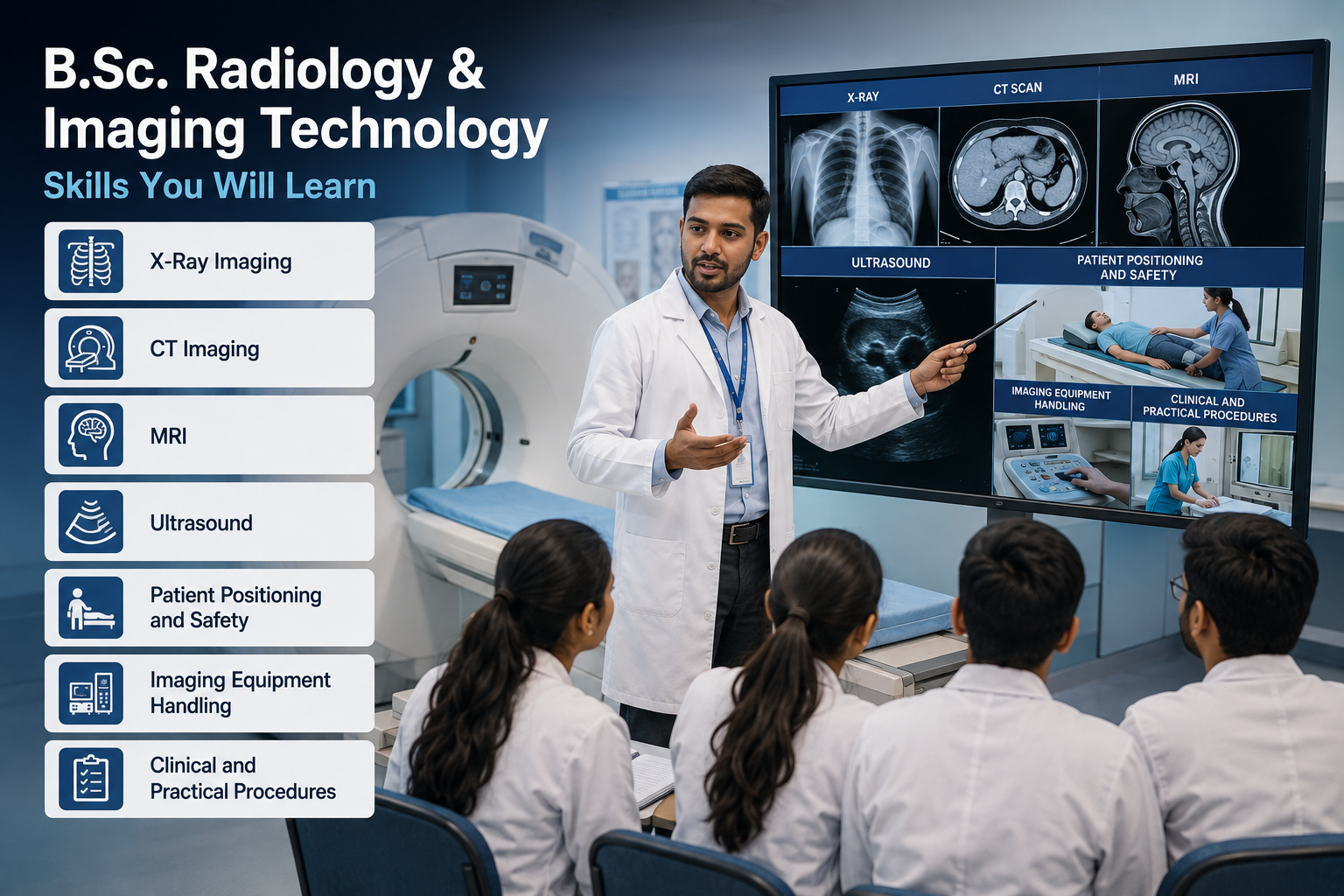
Practical training helps students apply classroom knowledge to imaging procedures and healthcare situations. The program may include learning related to:
- X-Ray Imaging
- CT Imaging
- MRI
- Ultrasound
- Patient Positioning and Safety
- Imaging Equipment Handling
- Clinical and Practical Procedures
At Longowal Group of Colleges (LGC), students can gain practical exposure to key imaging technologies supporting their understanding of radiology procedures in healthcare settings.
How to Choose a B.Sc. Radiology College in Chandigarh?
Choosing the right college is an important step when planning a career in medical imaging. If you are comparing options for B.Sc. Radiology & Imaging Technology in Chandigarh, consider these key factors:
- Curriculum
- Practical and Clinical Training
- Imaging Facilities
- Faculty and Learning Support
- Career and Placement Support
- Fees and Scholarships
- Location and Accessibility
Comparing these factors can help you choose the right institution for your goals. LGC is also an option to consider for students exploring radiology programs near Chandigarh.
Why Choose LGC for B.Sc. Radiology & Imaging Technology?
Longowal Group of Colleges (LGC), Derabassi, near Chandigarh, offers B.Sc. Radiology & Imaging Technology as a 4-year undergraduate program. For students considering B.Sc. Radiology & Imaging Technology in Chandigarh, LGC provides a course-focused learning environment with practical exposure and career-oriented support.
Key features include:
- Dedicated B.Sc. Radiology & Imaging Technology program
- Practical learning related to imaging procedures
- Exposure to X-ray, CT and MRI technologies
- Well-equipped learning facilities
- Faculty support
- Career guidance and placement assistance
- Other allied health science programs
For students planning a career in medical imaging, LGC offers an opportunity to combine academic learning with practical exposure and develop skills relevant to the healthcare sector.
Start Your Journey in Radiology & Imaging Technology
Ready to take the next step toward a career in medical imaging? – Explore the B.Sc. Radiology & Imaging Technology in Chandigarh program at LGC and learn about the course, eligibility and admission process.
Contact Longowal Group of Colleges (LGC) today to know more about admissions, fees, scholarships and course details.
Longowal Group of Colleges (LGC)
Address: College Road, Derabassi, Distt. SAS Nagar, Mohali (Near Chandigarh)
Call Us: 99151-58000, 81466-58000
Mail Us: enquirylgcderabassi@gmail.com
Final Thoughts: Build Your Future in Medical Imaging
A B.Sc. Radiology & Imaging Technology in Chandigarh can suit students interested in healthcare and medical imaging. Success in this field requires scientific knowledge, technical skills, practical exposure, attention to detail, patient communication and a strong commitment to safety.
At Longowal Group of Colleges in Derabassi, the B.Sc. Radiology & Imaging Technology program is a 4-year undergraduate course that combines medical imaging education with practical learning. Before applying, compare the curriculum, facilities, clinical exposure and career support and confirm the latest admission details, fees and scholarships.
Ready to turn your interest in medical imaging into a career? – Explore the B.Sc. Radiology & Imaging Technology program at LGC and take your next step with confidence.
FAQs – B.Sc. Radiology & Imaging Technology in Chandigarh: Course, Skills & Career Scope
Q1. Is B.Sc. Radiology a good career option?
Ans. Yes, B.Sc. Radiology & Imaging Technology can be a suitable career option for students interested in healthcare, medical imaging and technology. Career growth depends on practical skills, experience, further training and employer requirements.
Q2. What is the eligibility for B.Sc. Radiology?
Ans. At LGC, candidates should have passed 10+2 in the Medical stream or hold a Diploma in Medical Radiologic & Imaging Technology (MRIT). Students should verify the latest eligibility and admission requirements before applying.
Q3. What are the subjects in B.Sc. Radiology?
Ans. The curriculum can vary by institution but students may study anatomy, physiology, radiographic principles, medical imaging procedures, patient care, radiation safety, imaging equipment and practical training.
Q4. What can I do after B.Sc. Radiology?
Ans. After completing the course, graduates can explore opportunities related to X-ray, CT, MRI, ultrasound and other medical imaging services, depending on their qualifications, skills, employer requirements and applicable professional regulations. Further education or specialization may also be considered.
Q5. What jobs can I get after B.Sc. Radiology?
Ans. Potential career roles associated with the program include Radiologic Technologist, CT Scan/MRI Technician and Ultrasound Technician. The exact role and responsibilities depend on the graduate’s qualifications, skills, employer requirements and applicable regulations.