
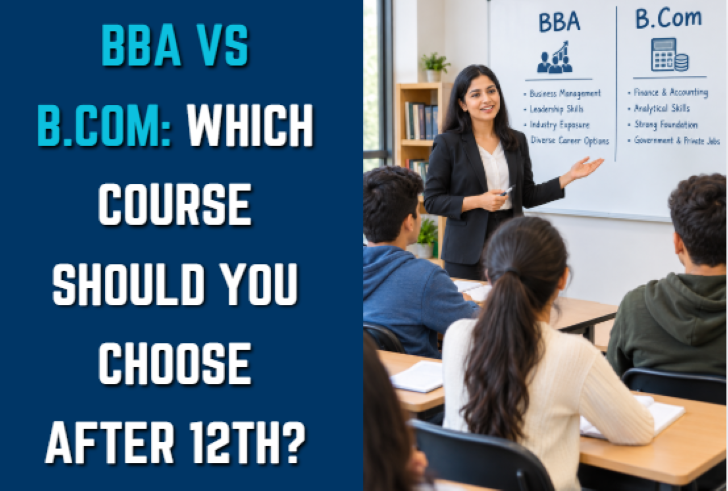
“One of the biggest decisions after Class 12 is choosing a course that matches your interests today and the career you dream of building tomorrow.”
Imagine two students finishing Class 12: one enjoys leading projects and building business ideas, while the other loves numbers, accounts and finance. Both have promising paths ahead but choosing BBA vs B.Com depends on their interests and career goals.
BBA focuses on management, marketing and business operations, while B.Com explores accounting, taxation and commerce. Both typically span three years in India, giving students time to build skills and plan their next career move.
Quick Insight: BBA vs B.Com — Which Is Better?
BBA vs B.Com depends on your career goals. BBA suits students interested in management, marketing and entrepreneurship, while B.Com is ideal for those drawn to accounting, finance, taxation and commerce-related careers.
What Is BBA?
- Full Form: Bachelor of Business Administration.
- Main Focus: Management, marketing, finance, human resources and business strategy.
- Learning Approach: Projects, presentations, case studies and internships.
- Skills Developed: Communication, teamwork, leadership and decision-making.
- Ideal For: Students interested in business, leadership and management careers.
What Is B.Com?
- Full Form: Bachelor of Commerce.
- Main Focus: Accounting, finance, taxation, economics and commerce.
- Learning Approach: Financial analysis, accounting exercises and commerce-related projects.
- Skills Developed: Numerical ability, financial analysis and attention to detail.
- Ideal For: Students interested in finance, accounts and commerce-related careers.
BBA vs B.Com: Key Differences
Understanding BBA vs B.Com can help you compare both degrees and choose the one that best matches your interests, academic strengths and career goals.
The table below provides a BBA vs B Com degree comparison, highlighting key differences in eligibility, duration, subjects and career options to help you choose the right course.
|
Comparison factor |
BBA | B.Com |
|
Full form |
Bachelor of Business Administration |
Bachelor of Commerce |
| Main focus | Management and business operations |
Commerce, accounting and finance |
|
Eligibility |
Class 12 pass; stream and minimum marks depend on the college | Class 12 pass; some colleges may specify subject requirements |
| Typical duration | 3 years |
3 years |
| Common subjects | Marketing, HR, management, business strategy |
Accounting, taxation, economics, auditing |
|
Learning approach |
Projects, presentations, case studies | Accounting exercises, financial analysis |
|
Career options |
Marketing, HR, operations, business development |
Accounting, banking, taxation, finance |
| Higher studies | MBA, PGDM, related programmes |
MBA, M.Com, CA and other relevant pathways |
Important Note: Eligibility, duration and admission criteria vary by institution and programme. Students should check the current requirements before applying.
In simple terms, the difference between BBA and B Com lies in their focus: BBA emphasises management and business operations, while B.Com centres on commerce, accounting and finance.

BBA vs B.Com Subjects: What Will You Study?
The BBA vs B Com subjects comparison helps you understand what each degree covers and which curriculum matches your interests. While BBA focuses more on management, B.Com emphasises accounting, finance and commerce.
Common BBA Subjects
Students pursuing BBA may study:
- Principles of Management
- Marketing Management
- Human Resource Management
- Business Communication
- Financial Management
- Organisational Behaviour
- Business Law and Entrepreneurship
Skills Gained: Develop an understanding of business operations, leadership, customer behaviour and organisational decision-making.
Common B.Com Subjects
Students pursuing B.Com may study:
- Financial Accounting
- Business Economics
- Business Law
- Cost Accounting
- Taxation
- Auditing
- Financial Management
Skills Gained: Develop skills in financial analysis, accounting, taxation and business decision-making.
Choosing between BBA vs B.Com becomes easier when you compare the subjects with your interests and career goals, as the right curriculum can help you build relevant skills for your future.
BBA vs B.Com Career Scope
The BBA vs B Com scope includes career opportunities in private companies, banks, financial services and government organisations. Salary and career growth depend on skills, experience, qualifications and job roles.
Career Opportunities After BBA
- Marketing Executive
- Business Development Executive
- Human Resources Executive
- Operations Executive
- Sales Executive
- Management Trainee
Career Opportunities After B.Com
- Accounts Executive
- Accounts Assistant
- Tax Assistant
- Audit Assistant
- Banking Associate
- Junior Financial Analyst
Both degrees offer diverse career paths, so the right choice in BBA vs B.Com depends on your preferred industry, professional goals and willingness to pursue further qualifications.
Government Jobs After BBA and B.Com
Both BBA and B.Com graduates can apply for government jobs, subject to the eligibility criteria of each recruitment examination.
- SSC CGL: Auditor, Accountant, and other eligible graduate-level posts.
- Banking Exams: Probationary Officer and other eligible banking positions.
- UPSC Civil Services: Civil service positions.
- State PSC Exams: Administrative and departmental posts.
- Railway Recruitment: Eligible graduate-level commercial and administrative roles.
- RBI Recruitment: Eligible officer and assistant positions.
Which degree is better for government jobs? Both offer opportunities. B.Com provides a useful foundation for accounting and finance-related exams, while BBA supports business and administrative knowledge. Selection depends on exam performance and eligibility.
BBA vs B.Com Salary in India
The BBA vs B.Com salary depends on the job role, employer, location and experience. The ranges below are broad estimates for entry-level roles, not guaranteed earnings.
|
Degree |
Entry-level role | Indicative annual salary |
|
BBA |
Marketing or Sales Executive | Rs. 2.4–4.5 lakh |
| BBA | Business Development Executive |
Rs. 2.5–4.5 lakh |
| BBA | HR or Operations Executive |
Rs. 2.4–4 lakh |
|
B.Com |
Accounts Executive | Rs. 2–3.6 lakh |
|
B.Com |
Tax or Audit Assistant |
Rs. 2–4 lakh |
| B.Com | Finance Support Roles |
Rs. 2.5–4.5 lakh |
To improve your earning potential, gain internship experience, strengthen communication and computer skills and learn relevant tools such as Excel, accounting software or digital marketing platforms.
Reference: AmbitionBox Salary Insights for salary estimates across different job roles in India.
BBA vs B.Com Professional Paths
The BBA vs B.Com professional paths differ based on the skills and qualifications students develop during their degree.
After BBA:
- MBA or PGDM
- Marketing and sales management
- Human resource management
- Business development and entrepreneurship
- Operations and project management
After B.Com:
- M.Com or MBA
- Chartered Accountancy (CA)
- Company Secretary (CS)
- Cost and Management Accountancy (CMA)
- Banking, taxation and financial analysis
Key Insight: CA, CS and CMA require additional professional examinations and qualifications after or alongside graduation.
Your ideal choice in BBA vs B.Com depends on whether you want to build a career in business management or specialise in commerce, accounting and finance.
How to Choose Between BBA and B.Com After 12th
If you are wondering “Is B.Com better or BBA?” or “BBA vs B.Com which is better?” The answer depends on your interests, preferred subjects and career goals. Consider these five factors before deciding:
- Your Interests: Choose BBA if you enjoy management and business operations or B.Com if you prefer accounting, finance and commerce.
- Your Career Goals: Identify your preferred career path and its qualification requirements.
- Course Subjects: Compare the syllabus and specialisations offered by each programme.
- College Facilities: Review faculty support, practical learning, internships and placement assistance.
- Fees and Budget: Compare tuition fees, additional expenses and available scholarships.
Ultimately, neither degree is universally better. Choose the course that matches your strengths, career plans and preferred learning style.
Ready to Choose Between BBA vs B.Com?
Still comparing BBA vs B.Com? Explore the programmes offered by Longowal Group of Colleges (LGC) in Derabassi, near Chandigarh and Mohali.
Longowal Group of Colleges (LGC)
Address: College Road, Derabassi, Distt. SAS Nagar, Mohali (Near Chandigarh)
Call Us: 99151-58000, 81466-58000
Mail Us: enquirylgcderabassi@gmail.com

Final Thoughts
Choosing between BBA vs B.Com depends on your interests and career goals. BBA suits students interested in management and business operations, while B.Com may appeal to those who prefer accounting, finance and commerce.
Before enrolling, compare the syllabus, fees and career opportunities. Longowal Group of Colleges (LGC) in Derabassi, near Chandigarh, offers programmes students can explore before making an informed decision about their future.
“Your degree is more than a qualification—it is the first step towards building a career that reflects your interests, strengths, and ambitions.”
FAQs – BBA vs B.Com: Which Course Should You Choose After 12th?
Q1. Is B.Com better or BBA?
Ans. B.Com may suit students interested in accounting, finance and taxation, while BBA may suit those interested in management, marketing and business operations. The better option depends on your goals.
Q2. BBA or B.Com: Which Is better for an MBA?
Ans. The answer to bba or b com which is better for mba depends on your interests and career goals. BBA provides an early foundation in management and marketing, while B.Com builds knowledge of accounting, finance and economics. Both degrees can lead to an MBA if you meet the admission requirements.
Q3. BBA vs B.Com Hons: Which Is Better?
Ans. The answer to bba vs b com hons which is better depends on your career goals. BBA suits students interested in management, marketing and entrepreneurship, while B.Com Honours may suit those who want specialised knowledge in accounting, finance, taxation and commerce.
Q4. BBA vs B.Com: Which Is Easy?
Ans. The answer to bba vs b com which is easy depends on your interests and strengths. BBA may suit students who enjoy presentations, teamwork and management projects, while B.Com may be a better fit for those comfortable with accounting, financial calculations, taxation and economics.
Q5. Is BBA better than B.Com for Business?
Ans. BBA offers an introduction to management, marketing and business operations, making it suitable for students interested in business leadership. However, B.Com can also support business careers, especially in finance, accounting and commerce-related fields.